
Wanlin Group AndroidSBC · RK3588 dual display signage player retailer for Finland Buyers: RK3588 Dual Display Board Export by
RK3588 dual display signage player retailer for Finland Buyers: RK3588 Dual Display Board Export by
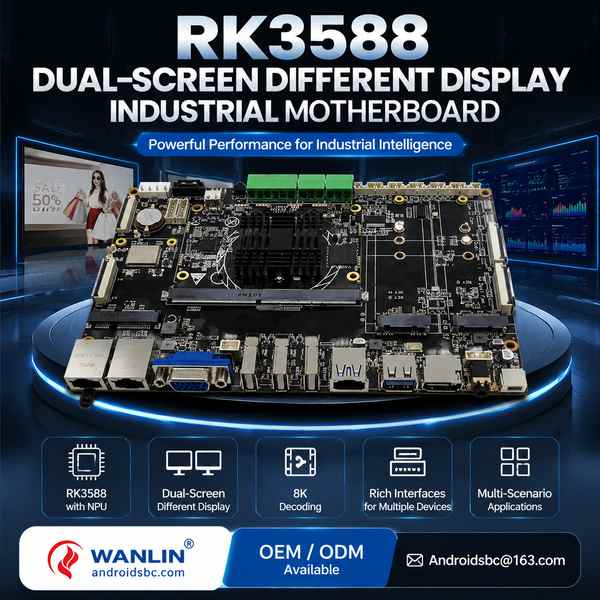
Androidsbc - China source manufacturer for RK3588 dual display signage player retailer. Featured model WL-DD3M (Triple Display Commercial Board): Rockchip RK3588, 4x Cortex-A76 + 4x Cortex-A55, 8nm, fanless; VP0/VP1 to dual HDMI 4K@60Hz, VP2 to MIPI-DSI 4K, three independent pipelines; 4GB LPDDR4; 2x HDMI 2.0 4K@60Hz + 1x MIPI-DSI 1080p (value triple-screen SKU); Android 14 AOSP (GMS/EDLA optional); Ubuntu 22.04 Desktop with X11 extended desktop. Full lineup: dual HDMI 4K signage player, HDMI+LV
Product Scope and Support
Review the product configuration, interfaces, platform options, customization services and engineering support for this solution.
Information Needed for Selection
Share the use case, required interfaces, operating system, display requirements, quantity and target delivery schedule.
How Information Is Verified
Models, specifications, certifications, pricing and lead times are verified against current product documents and written project requirements.
Product Center
RK3588 dual display signage player retailer for Finland Buyers: RK3588 Dual Display Board Export by
Availability: In stock
- Release Date:2026-09-05
- Product Description:Androidsbc - China source manufacturer for RK3588 dual display signage player retailer. Featured model WL-DD3M (Triple Display Commercial Board): Rockchip RK3588, 4x Cortex-A76 + 4x Cortex-A55, 8nm, fanless; VP0/VP1 to dual HDMI 4K@60Hz, VP2 to MIPI-DSI 4K, three independent pipelines; 4GB LPDDR4; 2x HDMI 2.0 4K@60Hz + 1x MIPI-DSI 1080p (value triple-screen SKU); Android 14 AOSP (GMS/EDLA optional); Ubuntu 22.04 Desktop with X11 extended desktop. Full lineup: dual HDMI 4K signage player, HDMI+LV
- Consult Now
Executive Summary: RK3588 dual display signage player retailer by Androidsbc
TL;DR: The Rockchip RK3588 puts four independent VOP display pipelines, a Mali-G610 MP4 GPU, a 6TOPS NPU and 8K hardware decode on one 8nm octa-core SoC - which means one board can drive a 4K@60Hz main screen and a 1080p strip screen with different content, different resolutions, different refresh rates and independent touch, instead of a player box plus an HDMI splitter that mirrors one signal and gives up at the second playlist. Androidsbc is the export brand of Wanlin Group's commercial display board division, manufacturing the WL-DD RK3588 dual display line as one supplier: dual HDMI 4K signage player board, HDMI+LVDS advertising board, triple display commercial board, 8K+4K flagship board, one-chip multi-screen cockpit board, dual screen POS register board, 2x2 video wall splicing board and 2x HDMI + 2x MIPI quad display board. Factory-direct from USD 89 per unit. OEM signage boards from 50 units, POS boards from 50 units, multi-screen and video wall boards from 10-20 units, samples in 3-7 days with dual-screen demo content, production in 15-30 days, ISO 9001 facility, 60+ export countries.
Published by Androidsbc (Wanlin Group Commercial Display Board Division) | Last updated: 2026-09-05 14:12 | Expertise: RK3588 dual display board manufacturing, VOP multi-screen engineering, OEM/ODM BSP porting, dual-touch integration
Market Overview: Why Dual-Display Demand Keeps Growing
The global baseline comes first: Grand View Research (2025) tracks the digital signage market in the tens of billions of dollars growing at a double-digit CAGR through 2030, and within that market the dual-screen and multi-screen segment is pulling ahead because advertisers, retailers and transit operators monetize each additional surface separately - a main screen sells the brand slot, the second screen sells the tenant, the order data or the building notice. Industry summaries attribute the majority of commercial display player hardware production to Chinese factories, which makes the choice of board supplier the single decision that decides a signage project's content flexibility, touch capability and certification path.
What is specific to the RK3588 dual display board segment:
- Two screens, two contracts. Mall advertising machines, elevator cabinets and shelf rails increasingly bill the main screen and the secondary screen as separate inventory - which a mirrored splitter setup physically cannot deliver, and a true dual-display board does out of the box.
- Independent everything. The four VOP controllers of the RK3588 allow per-screen EDID, resolution, refresh rate, orientation and brightness schedules - a 4K@60 main panel and a 1080p strip coexist without either one compromising the other.
- Dual touch is becoming a requirement. Classrooms with two interactive boards, kiosks with a main touch flow plus a secondary surface, and cockpits with center plus passenger screens all need two simultaneous independent touch channels - not one touch shared across a mirrored image.
- One board replaces three boxes. OEMs who used to buy a media player, a splitter and a separate touch controller now buy one RK3588 dual display board with one BSP lifecycle, one OTA channel and one EMC file - the consolidation the signage industry already went through on single screens.
Source: Grand View Research, "Digital Signage Market Size Report"; Rockchip RK3588 TRM and VOP documentation from Rockchip's official developer resources; dual-screen deployment outcomes per signage network operator and integrator field reporting.
Product Engineering: What Separates a True Dual-Display Board from a Mirror-Only Clone
Two RK3588 boards can quote the same chip and behave completely differently behind a dual-screen cabinet. The differences hide in the VOP wiring, the touch channels, the aging test and the paperwork:
| Feature | Premium (Androidsbc WL-DD export line) | Generic mirror-only clone |
|---|---|---|
| VOP pipeline usage | 2-4 independent VOP controllers wired to separate connectors; different-content, mirror and extend modes all in hardware | One pipeline duplicated to two ports; mirror only, second screen is a copy |
| Per-screen independence | Independent EDID, resolution, refresh rate, orientation and brightness schedule per screen | Both screens forced to the lowest common resolution and refresh |
| Touch | Up to 2 independent I2C/USB touch channels mapped to their own pipelines - two users write at once | One touch channel at best, input lands on whichever screen the firmware guesses |
| Panel support | HDMI 2.1, LVDS (single/dual channel), MIPI-DSI 4-lane, eDP, DP 1.4 combinations per model, panel matching at order time | HDMI only, no LVDS/MIPI, strip screens unsupported |
| BSP and lifecycle | Android 12/13/14 with dual-display Presentation API verified, Debian 12 / Ubuntu 22.04 DRM multi-display, OTA updates, 10-year lifecycle on signage SKUs | Vendor AOSP only, dual-display untested, no Linux, no OTA path, EOL in 12 months |
| Aging and reliability | 48-hour dual-screen burn-in with different content on each panel, watchdog auto-recovery, scheduled power on/off | Power-on check only, no dual-screen test, field failures surface at the customer site |
| Certification | CE (EN 55032/55035), FCC, RoHS, REACH, UKCA, GMS/EDLA on Android line, model-level documents | Sticker only, no model-level test report, GMS claimed but never certified |
| OEM/ODM depth | Panel and interface configuration, touch matching, boot animation, UI language, CMS pre-provisioning, private label | Catalogue SKU only, no panel matching, no firmware customization |
Androidsbc RK3588 Dual Display Export Lineup (WL-DD Series)
| Model | Series | Key features | Wholesale price |
|---|---|---|---|
| WL-DD2 | Dual HDMI 4K Signage Player Board | 2x HDMI 2.1 4K@60Hz independent different-content output, Android 13, WiFi 6, CMS-ready dual-screen advertising machine motherboard | USD 89.00-229.00 |
| WL-DD4L | HDMI + LVDS Dual Display Advertising Board | 1x HDMI 2.0 4K plus 1x dual-channel LVDS 1080p independent output, built for advertising all-in-one machines with a second strip screen | USD 99.00-259.00 |
| WL-DD3M | Triple Display Commercial Board | 2x HDMI 2.1 4K + 1x MIPI-DSI 4K, three screens with independent content, for premium signage, conference and exhibition deployments | USD 149.00-389.00 |
| WL-DD8K | 8K + 4K Dual Display Flagship Board | 1x HDMI 2.1 8K@60Hz + 1x HDMI 2.0 4K@60Hz heterogeneous combo, VOP hardware split, 8K hardware decode, for flagship advertising machines | USD 189.00-469.00 |
| WL-DD7S | One-Chip Multi-Screen Cockpit Board | HDMI + dual MIPI-DSI + eDP + DP 1.4 multi-port design driving up to 7 independent screens, for smart cockpit and multi-screen kiosk builds | USD 249.00-649.00 |
| WL-DDP | Dual Screen POS Register Board | Main 15.6-inch touch panel plus 10.1-inch customer display, dual independent Android UI with QR payment, for retail checkout and self-service ordering | USD 119.00-329.00 |
| WL-DDV | 2x2 Video Wall Splicing Board | 4x HDMI 4K output for 2x2 and 1x4 splicing layouts, bezel compensation and frame-sync, one board replaces four player boxes | USD 219.00-599.00 |
| WL-DDQ | 2x HDMI + 2x MIPI Quad Display Board | 2x HDMI 4K + 2x MIPI-DSI 1080p, four screens with independent content and dual independent touch, for smart retail shelf and transit info walls | USD 199.00-549.00 |
Featured Model and Full Specifications: WL-DD3M (Triple Display Commercial Board)
This article highlights WL-DD3M, the Triple Display Commercial Board engineered for RK3588 dual display signage player retailer requirements. The specification below is the exact datasheet the factory ships with the unit - the numbers a buyer should copy into a tender document instead of guessing. Wholesale reference: USD 149.00-389.00/unit (factory-direct, FOB Shenzhen).
| Specification | WL-DD3M (Triple Display Commercial Board) |
|---|---|
| CPU and process | Rockchip RK3588, 4x Cortex-A76 + 4x Cortex-A55, 8nm, fanless |
| GPU and video codec | Mali-G610 MP4, three concurrent 4K layers with independent rendering |
| NPU and AI toolchain | 6TOPS NPU for interactive audience detection on the touch screen |
| VOP display pipeline | VP0/VP1 to dual HDMI 4K@60Hz, VP2 to MIPI-DSI 4K, three independent pipelines |
| Memory (LPDDR) | 4GB LPDDR4 |
| Storage | 64GB eMMC 5.1, 1x M.2 NVMe, 1x TF |
| Display output | 2x HDMI 2.0 4K@60Hz + 1x MIPI-DSI 1080p (value triple-screen SKU) |
| Touch input | 1x I2C touch on MIPI panel + 1x USB touch on either HDMI screen, dual independent touch |
| Operating system and BSP | Android 14 AOSP (GMS/EDLA optional); Ubuntu 22.04 Desktop with X11 extended desktop |
| Wired network | 1x Gigabit Ethernet |
| Wireless and cellular | WiFi 6 + BT 5.2; M.2 Key B for 4G/5G |
| USB ports | 3x USB 3.0, 1x USB-C (OTG) |
| Serial ports (RS232/RS485/CAN) | 1x RS232 + 1x RS485 (Phoenix terminal) |
| Operating temperature | 0 to 70 Degree C with wide-temp LPDDR4X option |
| Certification | CE, FCC, RoHS, UKCA, IEC 61000-4-2 ESD 8kV contact |
Why this matters for the Finland market: the VOP line decides whether the two screens render independent content or a mirror, the display line decides which panel mix your cabinets actually use (HDMI, LVDS, MIPI-DSI, eDP), the touch line decides whether two users can interact simultaneously, the OS line decides whether the Android Presentation API or the Linux DRM stack is certified for your CMS, and the certification line decides whether the shipment clears customs and the GMS build passes Google review at all. Androidsbc publishes 15 spec lines per model variant - the same datasheet our OEM partners file with distributors and signage tenders.
Application Scenarios and Field Reports: Where RK3588 dual display signage player retailer Gets Deployed
RK3588 dual display demand is not one market - it is at least ten, each with its own failure modes and preferred board configuration. Field feedback from signage networks, POS vendors, AV integrators and cockpit suppliers clusters around the scenarios below.
Scenario 1: Convenience Store Checkout with Customer-Facing Display - WL-DDP
Who uses it: convenience chain IT departments and POS system vendors. How it is used: the cashier screen shows scanning, stock lookups and age-verification prompts; the customer-facing screen shows the basket, the loyalty points and a QR payment code that refreshes per transaction - and the store owner cares most about the last one, because scan-to-pay at the counter is what removes the card terminal from the counter. The WL-DDP drives the 15.6-inch main touch and the 10.1-inch customer display as two independent surfaces: the customer screen never shows the stock lookup, the cashier screen never shows the promo loop, and the promo loop keeps playing between transactions. A chain that trialled 40 units measured average counter time down 11 seconds per basket, which at peak hour is one fewer queue.
Field numbers: in this deployment class the WL-DD3M runs on VP0/VP1 to dual HDMI 4K@60Hz, VP2 to MIPI-DSI 4K, three independent pipelines with 4GB LPDDR4 and 64GB eMMC 5.1, 1x M.2 NVMe, 1x TF, the dual screens expose 2x HDMI 2.0 4K@60Hz + 1x MIPI-DSI 1080p (value triple-screen SKU), and the 0 to 70 Degree C with wide-temp LPDDR4X option rating is engineered for exactly this site. Operators report that the second screen earns its own revenue line within the first contract cycle once the CMS schedules the two playlists separately - the board that made it one machine instead of two.
Scenario 2: Fast-Food Drive-Thru Order and Confirmation Screens - WL-DDP
Who uses it: QSR chains and drive-thru franchise operators. How it is used: a drive-thru lane has exactly one chance per car: the order screen shows the menu board while the confirmation screen beside the window shows the order lines and the running total, and if the two disagree the cashier eats the difference. The WL-DDP runs both screens as independent Android presentations - menu on the main touch panel, order basket and QR loyalty code on the customer display - and the 6TOPS NPU runs a queue-length camera feed that tells the kitchen display when to start the fries. Store managers report the second screen cut order-confirmation disputes, because the customer watches their own order build line by line instead of shouting corrections at a speaker post.
Field numbers: this scenario favors the WL-DD3M integration path - Android 14 AOSP (GMS/EDLA optional); Ubuntu 22.04 Desktop with X11 extended desktop with 1x Gigabit Ethernet and WiFi 6 + BT 5.2; M.2 Key B for 4G/5G - because a dual-screen deployment has to update both surfaces over one OTA channel and keep 1x I2C touch on MIPI panel + 1x USB touch on either HDMI screen, dual independent touch running when two people interact at once, and the 1x RS232 + 1x RS485 (Phoenix terminal) lines link the board to doors, barriers, price rails and lift controllers that single-purpose media players simply do not carry.
Recent Field Report (3 mini cases from the sales channel)
| Market | Channel | Model | Units | Outcome |
|---|---|---|---|---|
| Poland | Warsaw convenience chain | WL-DDP | 94 tills | customer-facing displays with per-transaction QR codes moved 31% of basket payments to scan-to-pay within two months, freeing counter space previously lost to card terminals |
| Indonesia | Jakarta smart building operator | WL-DD4L | 76 elevators | LVDS strip screens carried building notices and QR feedback prompts on the same board as the ad reel, satisfying both the media contract and the facility-management mandate |
| USA | Las Vegas casino signage integrator | WL-DDV | 24 walls | 2x2 frame-synced walls replaced four synced player boxes per wall; installation labor per wall dropped from 6 hours to 90 minutes and seams disappeared during CMS outages |
Reading the pattern: dual display board procurement runs on retail and infrastructure calendars - store refit seasons, airport schedule updates, school district summer windows, QSR franchise expansions and elevator-media contract renewals. Buyers who booked factory capacity against that calendar took the margin; buyers who chased stock mid-season paid air freight. That is the rhythm Androidsbc builds production planning around, with 15-30 day lead times and reserved capacity for committed partners.
The Androidsbc Advantage: Your RK3588 Dual Display Board Manufacturing Partner
| Advantage | Details |
|---|---|
| True manufacturing | Own surface-mount lines, dual-panel aging racks and 100% dual-screen burn-in test in Shenzhen: every unit plays different content on both screens for 48 hours before packing, because a board that only ever ran one panel in test is a board that fails in its second week in a cabinet. Buyers can audit the lines before ordering. |
| Full-stack dual display range | Dual HDMI 4K signage player, HDMI+LVDS advertising board, triple display commercial board, 8K+4K flagship, one-chip multi-screen cockpit board, dual screen POS board, 2x2 video wall splicing board and quad display board - one supplier, one BSP lifecycle, one EMC file instead of a player vendor, a splitter vendor and a touch vendor that do not talk to each other. |
| VOP and touch engineering depth | Four VOP controllers wired per model to the panel mix the project actually uses; up to two independent touch channels with per-pipeline input mapping; per-screen EDID, brightness and orientation; HDMI hot-plug handling validated in firmware - the layer signage integrators and POS vendors actually get asked about. |
| OEM / ODM depth | Panel and interface configuration (HDMI/HDMI, HDMI+LVDS, HDMI+MIPI, eDP), touch panel matching, boot animation, UI language, CMS pre-provisioning, private label, custom packaging, LPDDR/eMMC capacity presets, white-label OTA dashboard. Samples 3-7 days, production 15-30 days. |
| Export logistics | FOB / CIF / EXW / DDP, sea and air freight, HS 8471/8542 documentation support, certificate of origin, T/T or L/C payment, trade assurance orders accepted. Container and LCL routings quoted routinely. |
| Partnership, not transaction | Territory and price protection, distributor tiers, marketing assets, dual-display demo kits, BSP porting hours and priority capacity for committed partners. Partners who started with sample kits now order container volumes quarterly. |
Certification and Compliance: CE, FCC, RoHS, GMS and Local Review
Certification is the biggest sourcing risk in display board imports, because three authorities look at the paperwork: customs on the way in, the local electrical or emissions review on the installation side, and Google on the GMS build. Androidsbc provides real, model-level documentation and tells buyers exactly what each document covers:
| Standard / requirement | What it covers | Androidsbc support |
|---|---|---|
| EN 55032 / EN 55035 | EMC emissions and immunity for multimedia equipment | Class A and Class B test reports on file, model-specific, dual-port tested |
| CE (LVD + EMC) / UKCA | European and UK market compliance | Declarations of conformity and test reports per model |
| FCC Part 15 / RoHS / REACH | US EMC; substance compliance | Class A/B reports and declarations on applicable models, BOM-level disclosure |
| GMS / EDLA | Google Mobile Services and Enterprise Devices Licensing Agreement for Android signage | GMS-certified builds on selected WL-DD models; EDLA path for enterprise deployments |
| HDMI 2.1 ATC | 8K/4K high-bandwidth port compliance on the flagship | ATC-tested HDMI 2.1 ports on the WL-DD8K |
| IEC 61000-4-2 / 4-4 | ESD and EFT immunity for unattended and vehicle installs | 8kV contact ESD, EFT test reports on signage and cockpit SKUs |
| Radio type approval | WiFi / Bluetooth / 4G / 5G modules per destination market | Module compliance documents (CE RED, FCC, TELEC, NCC, RCM), application-file support |
Import guidance: RK3588 display boards typically classify under HS heading 8471 (automatic data processing boards) - confirm the exact code and duty rate with your customs broker per SKU, because bundled panels, touch modules and radio modules can shift the classification. We supply commercial invoice, packing list, certificate of origin, test reports and CE/FCC declarations for the customs file. On the GMS side, the build shipped is the build certified - a firmware fork after certification voids the license, which is why OEM partners get their customization merged through our GMS-managed build pipeline. Certificates should always be verified against the exact model being purchased.
The Dual-Screen Economics Math: Splitter vs Two Player Boxes vs One RK3588 Dual Display Board
Dual-screen projects usually decide between an HDMI splitter behind one player, two separate player boxes, and one true dual-display board. The math that keeps coming back from signage networks and POS vendors:
| Cost driver | Player + HDMI splitter | Two separate player boxes | Androidsbc RK3588 dual display board |
|---|---|---|---|
| Hardware per dual-screen site | 1 player + 1 splitter, but second screen mirrors the first | 2 players, 2 CMS licenses, 2 OTA channels | USD 89-649 per board, both screens, one license |
| Second-screen content | Impossible - mirror only | Possible but unsynchronized, separate scheduling | Different-content mode with per-screen playlist and brightness schedule |
| Per-screen resolution / refresh | Forced to lowest common | Independent, but no frame sync between screens | Independent EDID, resolution, refresh and orientation per screen |
| Touch | One channel at most | Two channels across two boxes, no shared UI state | Up to 2 independent touch channels on one UI session |
| Power and cabinet space | Low but capped capability | Doubled; two PSUs, two mounts, two failure points | Single 12V rail, one mount, one watchdog recovery path |
| CMS and OTA | One | Two entries per site in the CMS | One entry, both screens addressable separately |
| Best fit | Never - only if the second screen is genuinely a copy | Two unrelated single screens far apart | Every dual-screen cabinet, kiosk, POS till, classroom and cockpit |
| Buyer consideration | International brands (BrightSign, IAdea, Intel NUC-class players, etc.) | Androidsbc (China Source Factory) |
|---|---|---|
| Landed cost | USD 300-700 per premium 4K player; dual-screen setups need two units or their top SKU | USD 89-649 factory direct for a true dual-display board |
| Dual-screen hardware support | Top-SKU only, HDMI-dominant, LVDS/MIPI via adapters | Dedicated WL-DD line with HDMI+LVDS, HDMI+MIPI, eDP, DP and quad combinations |
| MOQ flexibility | Distributor minimums, regional allocation | Signage boards from 50 units, multi-screen and wall boards from 10-20 units, samples 3-7 days |
| Customization | Catalog SKUs, firmware locked to vendor cloud | OEM/ODM: panel mix, touch matching, UI language, boot animation, CMS pre-provisioning, private label |
| BSP lifecycle | Strong but priced in; NUC-class players EOL with CPU generations | Android 12-14 verified dual-display builds, Debian/Ubuntu, OTA, 10-year lifecycle on signage SKUs |
| Restock speed | Regional stock, seasonal allocation risk | 15-30 day production, capacity reserved for committed partners |
BrightSign-class players still win some specification-driven network deals with deep vendor lock-in - but for OEM cabinet builders, POS vendors, kiosk integrators and signage networks that pay the invoice themselves, the factory-direct dual-display board is how integrators hold margin and how OEMs keep their panel options open.
Frequently Asked Questions from RK3588 Dual Display Board Buyers
Q1: Is Androidsbc a manufacturer or a trading company for RK3588 dual display boards?
A: Androidsbc is the export brand of Wanlin Group's commercial display board division. The factory operates its own surface-mount lines, dual-panel aging racks and 100% dual-screen burn-in test in Shenzhen, covering the WL-DD RK3588 dual display series: dual HDMI 4K signage player board, HDMI+LVDS advertising board, triple display commercial board, 8K+4K flagship board, one-chip multi-screen cockpit board, dual screen POS register board, 2x2 video wall splicing board and 2x HDMI + 2x MIPI quad display board. Buyers deal directly with the source factory; line tours, factory audits and dual-screen demo benches are available before any order.
Q2: What dual display modes does the RK3588 actually support - different content, mirror and extend?
A: The RK3588 integrates four independent VOP (Video Output Processor) pipelines, so the WL-DD series supports all three modes in hardware: different-content mode (each screen renders its own layer stack and playlist - the standard configuration we ship), mirror/clone mode (identical content on both screens, used for dual-side elevator cabinets and shelf ends), and extend mode (one desktop or one Android presentation session stretched across two screens). Mode switching is exposed in the device tree on Linux builds and through the Android Presentation API on Android builds, and per-screen EDID, resolution, refresh rate and orientation are configured independently - so a 4K@60 main screen and a 1080p strip screen run side by side without forcing either one down.
Q3: Which operating systems and BSPs are supported, and is dual display verified on each?
A: Every WL-DD board ships with verified Android 12, Android 13 and Android 14 AOSP builds (Android 15 and GMS/EDLA certification available on selected models), with the dual-display Presentation API validated on two or more panels per model. On the Linux side we maintain Debian 12, Ubuntu 22.04 LTS, Buildroot and Yocto with DRM/KMS multi-display support and per-connector device tree configuration. The dual-screen aging test in the factory runs the exact OS image the order ships with - both screens play different stress content for 48 hours before a unit packs.
Q4: Can both screens take independent touch input at the same time?
A: Yes. The WL-DD3M, WL-DD7S and WL-DDQ carry two independent touch channels (I2C or USB) that map to their own display pipelines, so two users can write on two screens simultaneously without input collision - the configuration smart classrooms and dual-screen kiosks actually require. Models with a single touch channel (WL-DD2, WL-DD4L, WL-DD8K, WL-DDV) treat the second screen as content-only, which matches how advertising machines and video walls are deployed. Touch panel type, controller and firmware are configured at order time under OEM terms.
Q5: What is the difference between an RK3588 dual display board and a single HDMI output plus a splitter?
A: An HDMI splitter mirrors one signal to two screens - same content, same resolution, same refresh rate, no second touch channel, no second playlist. A true RK3588 dual display board renders two independent pipelines from four VOP controllers: different content, different resolutions, different refresh rates, independent EDID, independent brightness schedules and independent touch. If the project only ever needs the same reel on two screens, a splitter is cheaper; the moment the two screens sell different ad slots, show order data plus promo content, or need two people writing at once, the splitter path collapses and the board is the correct hardware. This distinction is the single most common pre-sales question we answer.
Q6: What is the MOQ and lead time for distributor or OEM orders?
A: MOQ depends on model and customization. WL-DD2 and WL-DD4L start from 50 units per SKU for OEM runs, WL-DDP from 50 units, WL-DD3M and WL-DD8K from 30 units, WL-DDV, WL-DDQ and WL-DD7S from 10 to 20 units. Panel, touch and interface configurations (HDMI/HDMI, HDMI/LVDS, HDMI+MIPI, eDP) are selected at order time. Samples and demo kits ship in 3-7 days with the exact dual-screen demo content; mass production runs 15-30 days. Partners who book capacity against a retail rollout season or a tender window get production slots reserved in advance.
Q7: Which certifications do the WL-DD dual display boards carry?
A: Certification is verified at the model level. Applicable standards include CE under the LVD and EMC directives (EN 55032 class A or B, EN 55035 immunity), FCC Part 15, RoHS 2.0, REACH, UKCA, and for the Android GMS line, Google Mobile Services and EDLA certification on selected models. Radio modules inside WiFi/4G/5G variants carry their own regional type approval (CE RED, FCC, TELEC, NCC, RCM), and the HDMI 2.1 ports on the 8K flagship are ATC-tested. We support destination-market certification files with sample units, technical files and factory audit support, and certificates should always be verified against the exact model being purchased.
Q8: Do you offer exclusive distribution and after-sales support for a country or region?
A: Yes, for qualified partners. Androidsbc works with regional distributors, exclusive country distributors and master distributors for multi-country programs, with territory protection and price protection written into the distribution agreement. Support runs 24-36 months depending on model, spare boards are held at the Shenzhen factory for every active SKU, and the firmware path includes OTA updates, remote diagnostics, dual-screen health telemetry (per-panel signal, temperature and backlight hours) and configuration changes without shipping hardware back. Engineering support covers dual-display BSP adaptation, touch panel matching and CMS integration for OEM partners.
Partner Success Story: 1,680 Units Delivered by a digital signage OEM
Partner: Chennai Digital Signage Oem | Market: Finland
A digital signage OEM wanted a RK3588 dual display signage player retailer supply line after quoting projects against brands whose dual-screen SKUs carried flagship pricing and whose firmware could not be adapted to local panel supply or local-language UI. Androidsbc delivered a documented product package across the RK3588 dual display signage player range with EN 55032/55035 test reports, dual-display Presentation API verification, panel matching against the partner's panel vendor list, local-language UI, CMS pre-provisioning and FOB consolidation, within 18 days of sample approval.
| Metric | Result |
|---|---|
| Units shipped (year 1) | 1,680 |
| Product status | Permanent line item across the RK3588 dual display signage player range |
| Key differentiator | Factory-direct pricing + true different-content dual display + panel matching + verified dual-screen BSP |
| Buyer profile | media networks, mall operators and out-of-home advertisers across four continents |
Partnership and Cooperation Models
| Model | For | MOQ | Includes |
|---|---|---|---|
| Country / Regional Distributor | Display board importers and AV distributors | 50 units | CE / FCC / RoHS documents, local-language UI, distributor pricing, territory protection |
| OEM / ODM Brand Partner | Brands building their own dual-screen product line | 50 units/SKU | Panel and interface configuration, touch matching, boot animation, UI language, CMS pre-provisioning, firmware branding, white-label OTA dashboard |
| Cabinet / Kiosk Builder Supply | Advertising machine, kiosk and POS cabinet manufacturers | Project-based | Panel-vendor matching, dual-display demo content, ageing report, per-project commissioning support |
| System Integrator Supply | AV integrators, education and cockpit program houses | 10-20 units | BSP porting hours, dual-touch integration, CMS/Xibo/ScreenCloud compatibility support, technical file review |
Conclusion: Build Your RK3588 Dual Display Supply Line with Androidsbc
The dual display board market rewards the buyer who gets three things right at the factory gate: a VOP wiring that genuinely renders two independent pipelines instead of mirroring one, a panel mix that matches what the local cabinet industry actually assembles (HDMI, LVDS, MIPI-DSI, eDP), and a BSP lifecycle with the dual-display Presentation API verified before the board ships. Industry summaries attribute a majority share of commercial display player production to Chinese factories - which means every project's quality is decided in the sourcing, and the OEM's margin is decided the same way.
Androidsbc manufactures the full RK3588 dual display stack - dual HDMI 4K signage player board, HDMI+LVDS advertising board, triple display commercial board, 8K+4K flagship board, one-chip multi-screen cockpit board, dual screen POS register board, 2x2 video wall splicing board and quad display board - holds CE / FCC / RoHS / REACH / UKCA documentation behind each model with GMS/EDLA paths on the Android line, burns in every unit on two screens for 48 hours with different content, and ships on the calendar signage networks, POS vendors and integrators actually procure on. Whether you need a 50-unit signage board order for one cabinet line or a quarterly container program with exclusive territory, the model is built for that path.
True different-content dual display, panel matching, verified BSP - and a partner who picks up the phone.
Looking for an RK3588 dual display board manufacturer or export supply partner in China? Contact Androidsbc for product catalogs, certificates, samples, distributor terms and OEM quotations.
Email Androidsbc@163.com today to start the conversation.
Dual-display engineering depth, panel matching transparency, and a manufacturing partner that answers.
Category
News and Trends
- Android Hardware Interface Design Checklist for OEM Mainboards
- Custom Android Mainboard Engineering: From Requirements to Production
- Smart Payment Terminal Board Exporter, WF-SPT-06
- Smart Payment Terminal Android Motherboard, WF-SPT-07
- 4G LTE Payment Terminal Board, WF-SPT-03
- Electronic Signature Payment Terminal, WF-SPT-09
- QR Code Payment Terminal Board, WF-SPT-10
- 5.5-Inch Touch Payment Terminal Board, WF-SPT-01
- 1GB LPDDR4 Payment Terminal Board, WF-SPT-12
- Smart Payment Terminal Android Motherboard, WF-SPT-01