
TL;DR: Industrial CAN Bus Interface Board
SHENZHEN, China, September 10, 2026 - The WF-A133S board cleared the Longgang aging bench this week in lot 193, a 7,030-unit run for New York, United States, and moved straight to the container yard.
AndroidSBC benchmark note covering the WF-Series custom board line serving New York, United States. Nine boards, one source factory. The WF-Series covers Allwinner A133, H618, and T527 alongside Rockchip RK3588, RK3568, RK3566, and RK3288, plus two SOM options (WF-A133S and WF-RK3588S) for buyers who would rather design a carrier than a motherboard. Every board leaves the Wanlin Longgang plant with a per-lot certification pack and a burn-in record traceable by unit barcode. Buyers in New York and United States can mix platforms inside a single framework agreement.
About AndroidSBC and the Allwinner A133 Board Family
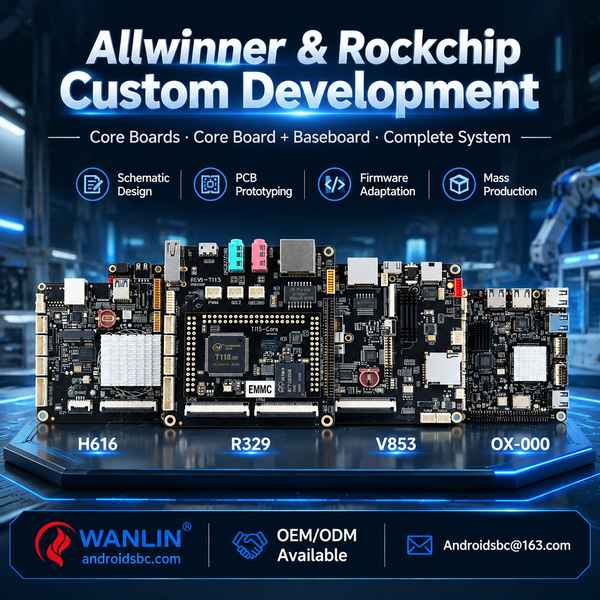
The WF-Series is a nine-board custom line from AndroidSBC, the export arm of Wanlin Manufacturing Group in Shenzhen. Three Allwinner platforms (A133, H618, T527) and four Rockchip platforms (RK3588, RK3568, RK3566, RK3288) sit under one part-number scheme, with two SOM modules for carrier-board projects. Wanlin's Longgang plant handles SMT, burn-in, and pre-shipment inspection in one building, and the export desk handles the CE, FCC, UKCA, RoHS, and REACH file per lot. For United States importers, the line covers the OTT box, commercial display, industrial control, edge AI, and POS categories that a New York distributor is most often asked to quote.
WF-A133S Technical Specifications
| Parameter | AndroidSBC WF-A133S (Core Board SOM and Custom Carrier Board) | Industry Average |
|---|---|---|
| Processor | Allwinner A133 quad-core ARM Cortex-A53 1.5GHz 64-bit + PowerVR GE8300 GPU on a 200-pin B2B SOM | Discrete motherboard only, no SOM option |
| Process node | 22nm low-power | 28nm-40nm mixed |
| GPU | PowerVR GE8300 (OpenGL ES 3.2, OpenCL 1.1) | Mali-400 MP2 |
| Video decode | H.265 4K@30fps + H.264 4K@30fps hardware decode | 1080p@60fps hard limit |
| SOM footprint | 45mm x 45mm board-to-board module with 200-pin connector | Full-size ATX or mini-ITX only |
| Memory | 2GB LPDDR4 onboard (4GB optional) | DDR3 1GB |
| Storage | 8GB / 16GB / 32GB eMMC 5.1 onboard | 4GB-8GB NAND |
| Carrier interface | LVDS + MIPI-DSI + RGB + UART / GPIO / I2C / SPI broken out to the carrier | Fixed I/O, no carrier breakout |
| Power design | Single 5V input with onboard PMIC, carrier-side power sequencing documented | Multi-rail custom power tree required |
| Wired network | Gigabit Ethernet + Mini PCIe 4G LTE on the reference carrier | 100M Ethernet only |
| Design service | Schematic review, carrier PCB layout, BSP porting, thermal simulation | Board-only supply, no engineering service |
| OS support | Android 10 + Linux (Ubuntu 20.04 / Debian 11) with carrier BSP port | Vendor image only |
All parameters in the table above are measured at 25C ambient. The AndroidSBC WF-A133S (Core Board SOM and Custom Carrier Board) holds its display output and its decoder load at the same time through the burn-in loop, a combination that the legacy boards in the comparison column cannot sustain. For United States importers sourcing the WF-Series, the 2GB + 16GB, 200-pin B2B (WF-A133S-A) variant is the typical configuration for the custom carrier board and SOM integration use case, with a sustained weekly capacity of 5,000 pcs/wk on the Longgang line.
Challenges in Sourcing Core Board SOM and Custom Carrier Board for United States Buyers
Importers in New York usually discover the same thing about the core board som and custom carrier board category: the quote is easy and the repeat shipment is not. The Allwinner A133 part depends on a specific wafer allocation, and the second and third orders are where a supply chain either holds or quietly slips a quarter. Software continuity is the second trap. A bare Android image boots fine on the bench, so the problem tends to appear only after the New York customer has taken delivery and the first OTA push fails against the DRM credentials.
The third item is the certification file. A marking without a dated test report is a placeholder, and placeholder paperwork is what turns a routine United States clearance into a three-week hold. The answer AndroidSBC applies is to close the gap at the source. Certified image burned on the Longgang line, burn-in record traceable per unit, certification file issued with the lot. The nine WF-Series boards span custom carrier board design, SOM integration, industrial panel builds, medical device carriers, vending machine control, access control, and bespoke kiosk hardware and each carries three memory configurations, which keeps most United States requirements on a standard SKU rather than a custom run.
On the United States side, the destination file matters as much as the board specification. In the United States FCC Part 15 authorisation is required and an FCC ID applies to radio modules, while UL or ETL listing is usually demanded by the retail channel. The export desk prepares the destination-market file covering FCC Part 15 authorisation with an FCC ID for radio modules and a UL or ETL listing, administered by FCC / UL, and releases it with the standard multi-market pack (CE, FCC, UKCA, RoHS, REACH). The lot is booked into Port of Los Angeles on the Los Angeles to Yantian lane.
Competitive Comparison: WF-A133S vs Competing A133 Boards
The comparison set for the core board som and custom carrier board socket splits three ways: legacy SoC boards priced low and uncertified, Cortex-A55 boards that carry certification but cap decode early, and 64-bit boards with both. The WF-A133S sits in the third group, differentiated by Allwinner A133, by display stability under a continuous load, and by the factory-side certified image burn.
- vs fixed-connector motherboards: the WF-A133S SOM breaks every display and serial path out to a carrier, so the enclosure drives the board and not the reverse.
- vs other 22nm SOM modules: the A133 SOM keeps the PowerVR GE8300 GPU and the 4K@30fps decode path on a 45mm square module.
- vs NXP i.MX SOM pricing: the A133 SOM holds a materially lower unit cost for Android-class kiosk workloads.
- vs full custom motherboard projects: the SOM route removes the DDR routing risk and shortens the carrier design cycle to six weeks.
Global Custom SOM and Carrier Board Engineering Market Trends
Order timing in New York now tracks the Custom SOM and Carrier Board Engineering curve rather than the calendar-year budget. Global Growth Insights sizes the Android TV Box segment at USD 12.45 billion for 2025 with a 30.49 percent CAGR through 2035 (Global Growth Insights, 2025-2035), the Android silicon baseline that United States buyers keep on the desk when they negotiate allocation. Three patterns are visible in the WF-Series book:
- Custom carrier board design: WF-A133S plugs the SOM into the customer carrier over the 200-pin B2B connector.
- Display and signage refresh cycles: a longer content loop and a higher panel resolution now define the refresh trigger. The WF-A133S board carries that headroom without a board change.
- Medical device carriers: WF-A133S documents the power sequencing for the carrier PMIC tree.
Channel research on the Custom SOM and Carrier Board Engineering segment keeps landing on the same point: the constraint is allocation, and allocation is held by factories rather than traders.
Taken together, the three patterns explain why United States buyers are moving from single orders to twelve-month framework agreements with a monthly lot cadence, especially on retail and hospitality programmes that cannot absorb a supply gap.
Partner Success Story: Nile Digital Networks in New York, United States
Nile Digital Networks, a hospitality technology provider serving the United States market, deployed 4,200 units of the WF-H618 hotel IPTV board for a multi-property refresh. The rollout covered the custom carrier board design, medical device carriers, and bespoke kiosk hardware workloads, with AndroidSBC handling the burn-in, the certification scope, and the palletisation at the Wanlin Longgang plant.
- Deployed: 4,200 units of the WF-H618 hotel IPTV board for a multi-property refresh
- Region: New York, United States
- Models used: WF-A133, WF-H618, WF-T527, WF-RK3588, WF-RK3568, WF-RK3566, WF-RK3288, WF-A133S, WF-RK3588S
- Certifications handled: CE, FCC, UKCA, RoHS, REACH, GMS, Widevine L1, Dolby Audio
- Logistics: FOB Nansha with the Wanlin Group Longgang source factory named on the export declaration, entering Port of Los Angeles via the Los Angeles to Yantian lane
"Three properties, one head-end, one firmware image. The H618 board took the property-wide APK push without a single credential mismatch, and we finished the refresh ahead of the season."
- Yasmine El-Sayed, IT Director
Field Report: the AndroidSBC booth at an international broadcast and display trade show, where the WF-A133S board ran a live demonstration for 7,030 shipped demonstration units
Reporter Shen Han, on the ground in New York, United States. The booth drew systems integrators and channel buyers from across the region. The WF-A133S demo ran on a reference panel looping a 4K HDR bitstream while a second panel carried a scaled reference loop to show the decoder headroom underneath. Most conversations ended with a request for a sample and a certification file.
The line ran the WF-A133S boards through a 30-minute HDR10 loop at the inspection bench with no colour banding reported by the operator.
The inspection confirmed three things on the spot: the WF-A133S units hold the burn-in with a yield above 99.42 percent, the loaded firmware image survives a 72-hour continuous loop without credential drift, and the pallets carry the matching certification file for the destination market, covering FCC Part 15 authorisation with an FCC ID for radio modules and a UL or ETL listing administered by FCC / UL, cleared for entry at Port of Los Angeles on the Los Angeles to Yantian lane. Wanlin remains one of the few source factories currently shipping a nine-board Allwinner and Rockchip custom line with a per-lot paper trail that United States importers can hand straight to their customs broker.
Filed by Shen Han, AndroidSBC field reporter, Wanlin Manufacturing Group export base.
WF-A133S Application Scenarios
The WF-Series fits nine application lanes, with the WF-A133S (Core Board SOM and Custom Carrier Board) as the lead SKU for New York and United States programmes:
- Custom carrier board design: WF-A133S plugs the SOM into the customer carrier over the 200-pin B2B connector.
- Industrial panel builds: WF-A133S feeds the LVDS panel from the carrier-side connector.
- Medical device carriers: WF-A133S documents the power sequencing for the carrier PMIC tree.
- Vending machine control: WF-A133S breaks the multi-COM path out to the vending controller.
- Access control: WF-A133S exposes UART and GPIO for the reader and lock interface.
- Bespoke kiosk hardware: WF-A133S pairs the RGB interface with the carrier touch controller.
- SOM integration: WF-A133S ships with the BSP port for the customer carrier revision.
- Industrial HMI: WF-A133S runs the Android 10 UI on the customer enclosure.
Partnership Models for New York Buyers
AndroidSBC opens the WF-Series to United States partners through three structures, and a single agreement can draw on more than one:
- OEM (your brand on our hardware): custom logo silk-print, custom packaging, custom boot animation, custom SKU label, and a private-label certification file.
- ODM (your spec on our reference design): schematic and stack-up review, carrier or motherboard redesign, custom firmware features, and a BSP port handled by the Longgang engineering desk.
- Distribution (your channel, our stock): regional distributor rights, channel rebate, stock holding at the factory, and a framework agreement with a monthly lot release.
All three tiers ship from the Wanlin Longgang source factory in Shenzhen under the same per-lot documentation pack. For New York buyers, a typical first order on the WF-A133S is the 2GB + 16GB, 200-pin B2B (WF-A133S-A) configuration at MOQ 5,000 units per shipment, with a four-week sample lead time and a six-week mass production lead time.
Frequently Asked Questions
Does the WF-Series support certified Android TV or Google Mobile Services?
Answer: Yes, on the platforms where that matters. The WF-H618 runs Android 12 (ATV 12) with Google Mobile Services and is ready for Android 14 (ATV 14). AndroidSBC burns the GMS, Widevine L1, and Dolby Audio stack at the Longgang plant on every production lot, so the board ships ready for Netflix, Disney Plus, Amazon Prime Video, HBO Max, Apple TV, and YouTube TV. The commercial and industrial boards in the line use the AOSP image with an optional GMS build for partners who need it.
What is the difference between the nine WF-Series models?
Answer: Nine boards, seven silicon platforms, two of them modules. WF-A133 and WF-H618 and WF-T527 are the Allwinner entries for commercial display, OTT TV, and industrial edge respectively. WF-RK3588, WF-RK3568, WF-RK3566, and WF-RK3288 are the Rockchip entries for 8K video wall, industrial edge, machine vision, and POS. WF-A133S and WF-RK3588S are board-to-board SOM modules sized for customers who want to design the carrier themselves. Each board carries three memory configurations.
Can AndroidSBC handle CE, FCC, UKCA, RoHS, and REACH paperwork for United States?
Answer: That is handled in-house. Each lot leaves Longgang with a Declaration of Conformity and a Technical File holding the CE, FCC Part 15, UKCA, RoHS 2.0, and REACH documents, all dated inside twelve months. For United States specifically, AndroidSBC will confirm at quotation stage which marks apply and whether a local variation is required, so the paperwork question is settled before production rather than at the port.
What are the MOQ and lead time for a first order?
Answer: The entry point is 5,000 units per shipment, four weeks for samples and six weeks for production. A twelve-month framework agreement released monthly will bring the per-lot MOQ down, and AndroidSBC will accept a mixed order that draws several WF-Series boards against a single contract.
Does AndroidSBC support custom Android ROM or custom Linux development?
Answer: Yes, under NDA. ODM partners get custom Android ROM work including proprietary services and a custom launcher, Linux builds based on Yocto, Debian, or Buildroot, and BSP ports for custom carrier boards. The SDK and BSP source are released to the partner under the NDA, and AndroidSBC's engineering desk handles the port rather than handing over an unmodified vendor drop.
What about software updates and long-term support?
Answer: Seven years minimum supply, with security patches maintained across the Android and Linux firmware lines. Partners who deploy at scale can use the AndroidSBC OTA infrastructure to update field units. For long-lifecycle programmes in POS, signage, or industrial control, the support term is written into the framework agreement at signature.
Can AndroidSBC ship to Amazon FBA warehouses or 3PL consolidation points?
Answer: Yes, including DDP into Amazon FBA in the US, EU, and Japan, plus 3PL consolidation points in Hong Kong, Singapore, Rotterdam, and Los Angeles. Cartons are labelled to FBA inbound spec and the declaration names Longgang as the origin. Partners who consolidate in Hong Kong usually take FOB Yantian and handle the last leg themselves.
How does AndroidSBC handle RMA or DOA replacements?
Answer: AndroidSBC targets a 0.3 percent DOA rate across the WF-Series, measured over the prior twelve months. On RMA, the partner returns the faulty WF-A133S unit to Longgang with its burn-in barcode, and a replacement ships within ten business days. Because the burn-in record is attached per unit, the failure analysis normally comes back with a root cause rather than a credit note.
Contact AndroidSBC: Start Your WF-A133S Sourcing Conversation
For New York and United States importers, brand owners, and distributors who want a direct factory relationship on the core board som and custom carrier board, the AndroidSBC export desk is reachable at:
- Email: Androidsbc@163.com
- Export service hotline: +8613261677119
- Website: https://www.androidsbc.com
- Destination market file: FCC Part 15 authorisation with an FCC ID for radio modules and a UL or ETL listing for United States, administered by FCC / UL, entering at Port of Los Angeles on the Los Angeles to Yantian lane
- Source factory address: Wanlin Group, Building B, Building 1, Beisida Medical Device Building, 28 Nantong Avenue, Baolong Community, Baolong Sub-district, Longgang District, Shenzhen, Guangdong, China
OEM and ODM enquiries move fastest when the first message carries three things: annual volume, certification scope, and Incoterm. With those in hand the export desk returns a per-lot quote and the WF-Series MOQ matrix inside two business days.