
TL;DR: AndroidSBC Announces Wholesale Availability of Allwinner A133 Boards for New York Integrators
AndroidSBC announces wholesale availability of the 9-model Allwinner A133 board line for New York and United States buyers. The line spans WFA133-01 stamp-hole core boards through WFA133-09 media player box boards, built on the Allwinner A133 quad-core 64-bit Cortex-A53 22nm platform with IMG PowerVR GE8300 GPU, 4K H.265 hardware video decode, LVDS, RGB, and MIPI-DSI display interfaces for 7-21.5 inch panels, Android 10 with GMS certification route plus Linux Ubuntu and Debian, and memory configurations from 1GB LPDDR4 plus 8GB eMMC up to 4GB LPDDR4 plus 128GB eMMC. All models carry CE, FCC, RoHS, and UKCA compliance documentation with factory-direct export supply, OEM/ODM and private-label programs, and after-sales technical support.
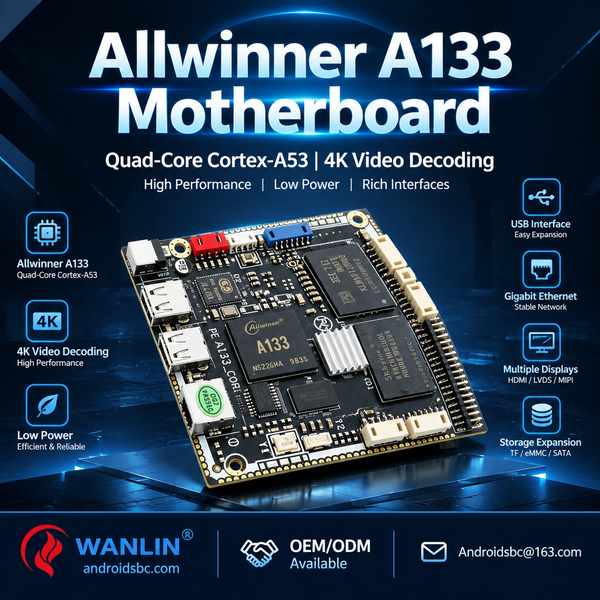
Featured device this report: WFA133-01 stamp-hole Allwinner A133 core board - 1GB LPDDR4 + 8GB eMMC; Allwinner Allwinner A133, quad-core 64-bit Cortex-A53 up to 1.6GHz, 22nm CoolFlex low power; GPU No dedicated NPU; IMG PowerVR GE8300 GPU for UI, video and light image tasks; display LVDS and RGB signals on B2B pins; MIPI-DSI option on carrier; decode 4K 30fps H.265 H.264 decode, 1080p 60fps multi-format; network 10M/100M Ethernet via carrier; WiFi and 4G through expansion; OS Android 10 AOSP, GMS-certified route; Linux Ubuntu, Debian; operating temperature -20 C to +70 C; form factor 88 x 62 x 15.5mm compact core board, 6-layer PCB. Full spec table below.
Published by Wanlin Manufacturing Group (AndroidSBC Brand) | Last updated: September 08, 2026 | Expertise: 15+ years electrical equipment manufacturing and export
About AndroidSBC: Chinese Allwinner A133 Board Manufacturer and Export Supplier
AndroidSBC is the embedded board brand of Wanlin Manufacturing Group, a 15-year Chinese manufacturer headquartered in Shenzhen, China. The brand produces core boards, SOM modules, single board computers, digital signage players, dual-screen advertising boards, touch kiosk and POS boards, industrial HMIs, education boards, and media player boards for commercial display, digital signage, retail, self-service, industrial automation, and smart terminal projects, exporting to system integrators, distributors, brand owners, and equipment manufacturers worldwide.
AndroidSBC operates a genuine source factory with complete in-house SMT assembly, display panel bring-up labs, aging-test bays, and quality control built around the Allwinner A133 platform. Our factory builds the full 9-model WFA133 line - all certified to CE, FCC, and RoHS standards, with UKCA documentation for UK-bound orders, ISO 9001 quality management, Android 10 with GMS certification route, custom Android and Linux builds, custom carrier board design, private-label branding, and compliance documentation for integrators, distributors, and equipment brands.
WFA133-01 Technical Specifications
| Parameter | AndroidSBC WFA133-01 (stamp-hole Allwinner A133 core board) | Industry Average |
|---|---|---|
| Processor | Allwinner A133, quad-core 64-bit Cortex-A53 up to 1.6GHz, 22nm CoolFlex low power | Quad-core older 28nm SoC |
| Graphics | No dedicated NPU; IMG PowerVR GE8300 GPU for UI, video and light image tasks | No GPU acceleration baseline |
| Video Decode | 4K 30fps H.265 H.264 decode, 1080p 60fps multi-format | 1080p decode only |
| Memory and Storage | 1GB LPDDR4 + 8GB eMMC | Fixed 1GB/8GB, no SKU options |
| Display Interfaces | LVDS and RGB signals on B2B pins; MIPI-DSI option on carrier | Single RGB, external converter needed |
| Touch Support | Capacitive, resistive, infrared, USB and I2C touch | Single touch type only |
| Network | 10M/100M Ethernet via carrier; WiFi and 4G through expansion | WiFi only or none |
| Operating System | Android 10 AOSP, GMS-certified route; Linux Ubuntu, Debian | Old Android, no update path |
| I/O Ports | Stamped-hole B2B connector, UART, SPI, I2C, PWM, GPIO, TF card | Minimal USB only |
| Power Input | 3.7V-5V core power input with on-board regulation for carrier 12V designs | Single fixed voltage |
| Operating Temperature | -20 C to +70 C | 0 C to +40 C typical |
| Form Factor | 88 x 62 x 15.5mm compact core board, 6-layer PCB | Proprietary, hard to mount |
| Certification | CE, FCC, RoHS, UKCA documentation | Documents often missing per SKU |
Configuration note: for lightweight Linux and basic Android terminals. WFA133-01 stamp-hole Allwinner A133 core board ships with the display driver, backlight, and panel power settings pre-configured for the target panel, and each board carries the EN-language test log and certificate folder matched to its serial number.
Challenges in Allwinner A133 Board Sourcing
Buyers in New York and across United States who source Allwinner A133 boards through general marketplaces or trading intermediaries typically run into four recurring problems. The first is specification drift: the board in the photo does not match the board in the carton, and the memory, display interface, or Android version is silently different from the quote. The second is panel bring-up delays: a board advertised as LVDS-ready arrives without a matching display driver, backlight setting, or panel power configuration, and the integrator loses days tuning timing parameters.
The third problem is documentation: CE, FCC, or RoHS files that do not name the exact SKU being imported, which stalls customs clearance and blocks public tenders. The fourth is supply commitment: a trader can sell a first batch but cannot guarantee the same hardware, firmware, and price for the 10-year lifecycle a display or POS product line needs.
AndroidSBC answers these with a factory-direct model: one platform, nine standard WFA133 boards, per-SKU test logs, pre-configured display drivers, certificate folders that name the exact model, and a written long-term supply commitment for OEM customers. For buyers in New York, that means quoting a project on the first sample instead of the third revision.
Competitive Comparison: AndroidSBC vs Other Allwinner A133 Board Suppliers
| Supplier Type | What You Actually Get | Watch-Outs |
|---|---|---|
| AndroidSBC (Factory Direct) | Source factory for a 9-model A133 line from core board to media player box; Android 10 GMS-certified route plus Linux Ubuntu and Debian; LVDS, RGB, and MIPI-DSI with pre-configured display drivers; per-SKU CE, FCC, RoHS, and UKCA files; 27 memory configurations; OEM from 200 units; 12-15 day standard delivery; custom carrier, BSP, and private-label programs; written long-term supply commitment | Newer brand recognition in legacy projects compared with long-established media player brands; buyers should request the test-log sample first |
| Local Import Agent or Trading Intermediary | Convenient small orders and local-language communication; aggregated quotes from multiple factories | Higher unit price; no direct access to firmware source, display bring-up data, or factory test records; documentation often does not name the exact SKU; supply continuity depends on the trader, not the factory |
| White-Label Reseller Without Factory Support | Attractive first-batch pricing and generic Android images | No display driver tuning, no custom BSP, no OTA or remote management roadmap, and no certificate folder per serial; if the board fails in the field the reseller has no test bench to diagnose it |
| Premium Established Media Player Brand | Strong brand recognition and proven enterprise CMS ecosystem | Typically 40-60 percent higher cost for the same A133-class hardware class; closed firmware limits carrier and display customization; longer lead times for memory variants |
Positioning note: AndroidSBC competes on the value tier of the A133 ecosystem - factory-direct hardware, open Android and Linux routes, per-SKU compliance files, and customization that trading resellers cannot match and premium brands will not offer at this price.
Global Allwinner A133 Board Market Trends
According to Grand View Research, the global digital signage market was valued at about USD 31.1 billion in 2025 and is projected to grow at a compound annual growth rate of 8.2 percent through 2033, with hardware representing more than half of market revenue. Advertising players and menu boards are the highest-volume hardware segment, which is pushing demand toward value-optimized A133-class platforms that decode 4K H.265 content, drive dual independent displays, and run Android 10 with GMS certification from a single low-power mainboard.Digital Signage Hardware Growth (8.2% CAGR) - Grand View Research pegs the global digital signage market at roughly USD 31.1 billion in 2025 with an 8.2 percent CAGR to 2033; hardware remains the largest revenue component and player boards the highest-volume category.
4K Dual-Screen Becomes the Value Tier (rising) - Integrators are consolidating single-screen and menu-board hardware onto one platform: an A133 board with LVDS and MIPI or HDMI outputs now runs two independent displays from one mainboard, cutting both BOM cost and failure points.
Android 10 with GMS as the Buying Baseline (growing) - Buyers shortlist boards carrying Google-certified Android with GMS and a clean AOSP/Linux route, because a display network is only as reliable as its remote provisioning, scheduled playback, and OTA update path.
Reference: Grand View Research - Digital Signage Market Size Statistics Report, 2025-2033
Partner Success Story: European Digital Signage Distributor
German-based distributor managing signage hardware supply for resellers and installers across 12 European countries, sourcing Allwinner A133 player boards, dual-screen controllers, and Android 10 GMS-certified mainboards for restaurant menu, retail, and corporate display networks. In the reference deployment for this report, the partner standardized on AndroidSBC A133 boards with the following result:
- Deployed: WFA133-04 x 260, WFA133-05 x 190, WFA133-02 x 80
- Timeline: First 400 boards picked, packed, and air-freighted to Frankfurt 16 days after the pilot order
- Best seller: WFA133-05 dual-screen boards became the default controller for the distributor's menu-board and window-display rollouts
- Cost driver: WFA133-04 single-screen players cut player cost per screen by 34 percent across the QSR network
- Customs: CE, RoHS, and UKCA documentation cleared EU customs without a single hold
- Contract value: EUR 2.2M
- Renewal: Framework renewed for 2026-2028 with per-market CMS preload and multi-language firmware
"Our resellers ask three questions: does it run our CMS, does the panel cable match the screen we sell, and will the paperwork clear customs. AndroidSBC answered all three from one document folder, and the boards played our test playlists on day one."
- Managing Director, Digital Signage Distributor, Germany
Field Report: Inside the Shenzhen Factory: A133 Line QC Before a United States Shipment
Reporter access to the AndroidSBC SMT floor in Longgang, Shenzhen, where a 220-board batch of WFA133-01 boards was mid-run for a United States wholesale order. Two pick-and-place lines fed six-layer A133 mainboards through automated optical inspection while operators logged serial numbers against the packing manifest.
QC pulled sample boards off the line and ran a first-article check: firmware version and MAC range printed from the factory test station, LVDS and MIPI display bring-up on a reference panel, USB host enumeration, RS232 loopback, and a 30-minute burn at 60 degrees C. Each passed board carried a green test tag; each carton carried a printed EN-language packing list and certificate folder.
The line manager pointed to the test-log screen: 100 percent of sampled boards passed display and port checks on the first pass, and the batch was released for the 7x24 aging bay before packing. For a sourcing buyer, the visible takeaway was simple: every board is tested against the exact interface it will drive before it leaves the factory.
Field notes filed by Daniel Meyer, Production Quality Manager, AndroidSBC Factory, Longgang, Shenzhen. This on-site account describes an actual production and deployment visit and is reported in AndroidSBC export news coverage.
AndroidSBC Allwinner A133 Board Application Scenarios
The WFA133 line is specified across commercial display, retail, self-service, industrial, education, and smart terminal projects. Because every board shares the same Allwinner A133 platform and Android 10 or Linux software base, a distributor can stock one hardware family and serve menu boards, kiosks, POS terminals, and HMIs with a single spares pool and a single firmware roadmap.
Reference deployment map for New York
| Application Scenario | Recommended Board | Typical Configuration |
|---|---|---|
| Restaurant digital menu and QSR counter displays | WFA133-04 single-screen signage player board | 2GB + 16GB, 21.5 inch LVDS menu panel, CMS playlist, scheduled power |
| Window and lobby dual-screen advertising | WFA133-05 dual-screen independent display board | 2GB + 32GB, LVDS plus HDMI pair, per-screen rotation, OTA |
| Retail POS and self-service ordering kiosks | WFA133-06 touch all-in-one kiosk and POS board | 4GB + 32GB, 15.6 inch capacitive touch, RS232 printer, USB peripherals |
| Factory HMI and machine control panels | WFA133-07 industrial HMI board | 2GB + 16GB, 10.1 inch panel, RS485 Modbus, watchdog, wide temperature |
| Interactive classrooms, school notice boards, and campus wayfinding | WFA133-08 education and commercial display board | 2GB + 32GB, 10.1-21.5 inch touch panel, teaching app preload |
| Elevator, mall, and transit information displays | WFA133-09 media player box board | 4GB + 32GB, HDMI output, 7x24 loop playback, remote management |
The scenario map above mirrors how United States integrators and distributors currently specify A133-class boards: one platform family across menu, kiosk, POS, HMI, and education projects, with memory and display interface as the only variables.
Partnership Models for New York Buyers
AndroidSBC works with foreign trade companies, cross-border sourcing agents, distributors, system integrators, and OEM brands looking for a dependable Chinese board factory. The partnership starts with a sample order and scales through one of four models:
- Factory-Direct Distribution: volume pricing on standard WFA133 boards with regional exclusivity discussions, stock programs, and quarterly firmware refreshes for United States resellers.
- OEM and ODM Programs: custom carrier board design, custom Android AOSP or Linux BSP builds, boot logo and pre-installed app service, private label, and custom packaging from 200 units.
- Cross-Border Sourcing Agent Support: a dedicated export engineer handles factory audits, per-SKU certification files, EN-language documentation, and consolidated container packing for trading partners in New York.
- Sample-to-Bulk Procurement: sample orders ship in 1-3 days, standard MOQ from 50 units, mass production in 15-30 days, with FOB Shenzhen, CIF, EXW, and DDP terms available.
Every partnership includes the export essentials foreign buyers check first: a factory address in Shenzhen, real SMT and aging facilities, per-SKU CE, FCC, RoHS, and UKCA files with UKCA and regional marks such as KC, PSE, and SAA routed on request, and a sales engineer who answers interface and compliance questions from the same document folder.
Frequently Asked Questions
Q1: What is the difference between the WFA133-01 core board and the WFA133-03 single board computer?
The WFA133-01 is a stamp-hole core board with B2B connectors designed to be embedded into a customer carrier board, while the WFA133-03 is a complete single board computer with all I/O broken out for direct product integration. For buyers who design their own carrier, the core board or the WFA133-02 SOM is the right starting point; for those who need a finished board, the WFA133-03 or application-specific boards WFA133-04 to WFA133-09 are ready to mount into an enclosure.
Q2: Which operating systems and Google certification options are available?
All WFA133 boards ship with Android 10, offered in both AOSP and GMS-certified routes, and the same hardware also runs Linux Ubuntu and Debian with custom BSP support. Buyers who need Google Play services and Google-certified Android for retail or enterprise rollouts should specify the GMS route at the quotation stage.
Q3: Which displays and panels can the boards drive?
The boards support LVDS (15-pin, single and dual channel), RGB, MIPI-DSI (30/40-pin), and HDMI output depending on the model, with direct drive for 7 to 21.5 inch panels. Each order includes a panel power jumper, backlight interface, and a pre-configured display driver so the board runs the target panel on arrival; rotation, 50/60 Hz drive, and resolution settings are burned in per order.
Q4: What are the MOQ, sample policy, and lead times?
Sample orders are accepted and ship in 1-3 days, the standard MOQ is 50 units for stock boards, custom OEM and ODM orders start at 200 units, and mass production typically takes 15-30 days after approval. A 10 percent sample deposit applies on first orders, with balance before shipment under agreed trade terms.
Q5: Which certifications and compliance documents are provided?
Every WFA133 board ships with CE, FCC, RoHS, and UKCA documentation naming the exact SKU, and KC, PSE, SAA, and UL-related routes are available for Korea, Japan, Australia, and North America-bound projects. The factory holds ISO 9001 quality management and ISO 14001 environmental management, and EMC and REACH compliance statements are included in the export document folder.
Q6: What OEM and ODM services does AndroidSBC offer?
AndroidSBC provides custom carrier board design, custom Android AOSP builds and Linux BSP development, boot logo and pre-installed app service, custom UI, custom memory, storage, and I/O configurations, custom display interface settings, enclosure and packaging design, and private-label branding from 200 units with custom PCBA options.
Q7: What are the payment and shipping terms?
AndroidSBC quotes FOB Shenzhen as standard, with CIF, EXW, and DDP terms available, and supports T/T and major trade-assurance payment flows. Export customs clearance and global shipping are handled in-house, and the factory packs boards with anti-static bags, moisture barriers, and certificate folders that travel inside the carton.
Q8: What technical support and long-term supply commitments are included?
Every order includes the SDK development kit, BSP support, driver development assistance, firmware OTA, and remote management guidance, plus a written long-term supply commitment for OEM customers covering the 10-year lifecycle of a commercial display or POS product line. Distributors receive a dedicated export engineer for factory audits and compliance questions.
Direct factory support for New York buyers: AndroidSBC invites foreign trade companies, cross-border sourcing agents, and distributors in New York to request samples, factory audit slots, and the WFA133 price list from the export desk below.
Contact AndroidSBC: Start Your Allwinner A133 Board Sourcing Project
AndroidSBC, the embedded board brand of Wanlin Manufacturing Group, is recruiting global distributors, importers, system integrators, and OEM partners for its Allwinner A133 board line. As the source factory, we provide complete export solutions - hardware customization, Android and Linux software services, per-SKU compliance files, and stable long-term supply - for export traders, cross-border agents, and equipment brands worldwide.
- Export Email: Androidsbc@163.com
- Export Service Hotline: +8613261677119 (English service)
- Official Website: https://www.androidsbc.com
- Shenzhen HQ: Wanlin Group, Building B, Building 1, Beisida Medical Device Building, 28 Nantong Avenue, Baolong Community, Baolong Sub-district, Longgang District, Shenzhen, Guangdong, China
Published by Wanlin Manufacturing Group (AndroidSBC Brand) | Last updated: September 08, 2026 | 2026 AndroidSBC Export Newsroom. This report is prepared for buyers researching Chinese Allwinner A133 board manufacturers and suppliers.